
Grey-water dump fees and rules in NZ
Where you can legally dump grey water, what counts as 'public sewer connection', etiquette. Honest, granular how-to — written from on-the-gr...
- logistics
Grey water in NZ means the used water from your sink and shower. It is not toilet waste, but it is still wastewater. You cannot drain it onto grass, into a gutter, or beside a DOC campsite because it has food scraps, soap, sunscreen, and bacteria in it.
This guide sits under Dump stations and water fills. It matters most on the South Island in 14 days route and the Queenstown + Fiordland loop, especially in December when sites are busy and Queenstown Lakes enforcement is tight.
Get the planning checklist that pairs this with the route-level gotchas for your trip, or reply with your dates if you'd like a planner to flag the grey-water-specific traps on your week.
Grey water is controlled wastewater, not spare water
Under the Freedom Camping Act 2011 and the 2023 self-containment amendment, a self-contained vehicle must be able to hold its wastewater and dispose of it properly. The standard behind that is NZS 5465:2001 for older certificates and NZS 5465:2022 for the newer green-warrant system.
The practical rule is simple. If it came from the sink, shower, or hand basin, it goes into an approved dump point. It does not go into a stormwater drain. It does not go into a public toilet. It does not go into a bush edge at Mavora Lakes, Lake Pukaki, Cascade Creek, White Horse Hill, or any other DOC-style camping area.
Grey water is usually less unpleasant than black water, but councils treat illegal discharge seriously because it reaches streams, lakes, and beaches fast. See doc.govt.nz for DOC campsite rules, and check the local council page for the district you are sleeping in.
What counts as a legal public sewer connection
A legal dump point is a signed wastewater disposal point connected to a public sewer, an approved septic system, or another authorised wastewater facility. On the ground, it is usually marked with a dump-station sign, a concrete pad, a hose for rinsing, and a capped inlet or grated receiving point designed for motorhomes.
A normal roadside drain is not a public sewer connection. In NZ, most street grates take stormwater straight to waterways. A public toilet is not a dump station either. Even if you could physically carry a bucket inside, it is not designed for grey-water volume, food particles, or chemical toilet waste.
Use council dump stations, holiday park dump points, some service stations, and marked facilities in larger towns. Around Queenstown, Wanaka, Te Anau, Nelson, Auckland, and the Coromandel, check before you arrive because access can change with construction, peak-season pressure, or council bylaw updates.
Fees, access, and the awkward holiday-park question
Many public dump stations are free. Some ask for a donation, coin payment, card payment, or a small use fee. Holiday parks often include dump access for overnight guests. If you are not staying, some will allow paid dump-and-water use, and some will not. Ask at reception before you drive over the pad.
Do not assume a dump point is public just because you can see it from the driveway. Oamaru Top 10, Rotorua Thermal Holiday Park, Hokitika Holiday Park, North South Holiday Park in Christchurch, Creeksyde Queenstown, and Russell Top 10 all operate in busy travel corridors, but each property sets its own access rules for non-guests.
Fees are not worth gaming. The legal risk is much larger than the saving. Enforcement officers can issue a $400 instant fine for freedom camping breaches. Illegal grey-water dumping can attract penalties of up to $200 per litre, with a maximum of $10,000 in serious cases.
A clean routine that keeps you out of trouble
Empty before you are full, not after. Most couples in a self-contained camper can fill a grey tank in two to three days if they shower in the vehicle and wash dishes normally. Families fill faster. A 6-berth gives more beds, but it also creates more wastewater and is harder to thread into small dump-station bays in older towns.
- Plan a dump stop every second travel day on busy routes.
- Use a proper hose or fitted outlet. Do not splash across the pad.
- Let black waste go first if using a cassette, then grey water, then rinse.
- Keep food scraps out of the sink with a strainer.
- Move on once finished. Dump stations are not parking bays.
On the Queenstown to Milford Sound drive, the Te Anau to Milford Sound drive, and the South Island in 10 days route, this routine matters because distances are long and legal facilities are clustered around towns. SH94 to Milford Sound is about 118 km from Te Anau and takes around 2 hours 15 minutes without long stops. Do not leave wastewater planning until you are already inside Fiordland.
Safer fallbacks if the dump point is closed or full
Council bylaws can be stricter than the national Act. Queenstown Lakes, Tasman, and Auckland are among the more restrictive areas for freedom camping and vehicle wastewater behaviour. The national law says what a vehicle must be capable of. Local bylaws decide where you may stop and how compliance is enforced locally.
If the dump station you planned to use is closed, blocked, frozen, or queued six vans deep, choose the dull fallback. Stay at a holiday park with dump access. Use a paid facility. Drive to the next town before cooking dinner and showering. In peak months, especially December and January, this is less stressful than trying to solve a full tank at 8 pm beside a lake.
Good fallback towns depend on your route. For Christchurch to Queenstown, think Christchurch, Geraldine, Lake Tekapo, Twizel, Cromwell, and Queenstown. For West Coast runs, plan around Hokitika, Franz Josef, Fox Glacier, Haast, and Wanaka. For North Island loops, Rotorua, Taupo, Wellington, Whangarei, and Kerikeri are safer than small beach settlements with tight local rules.
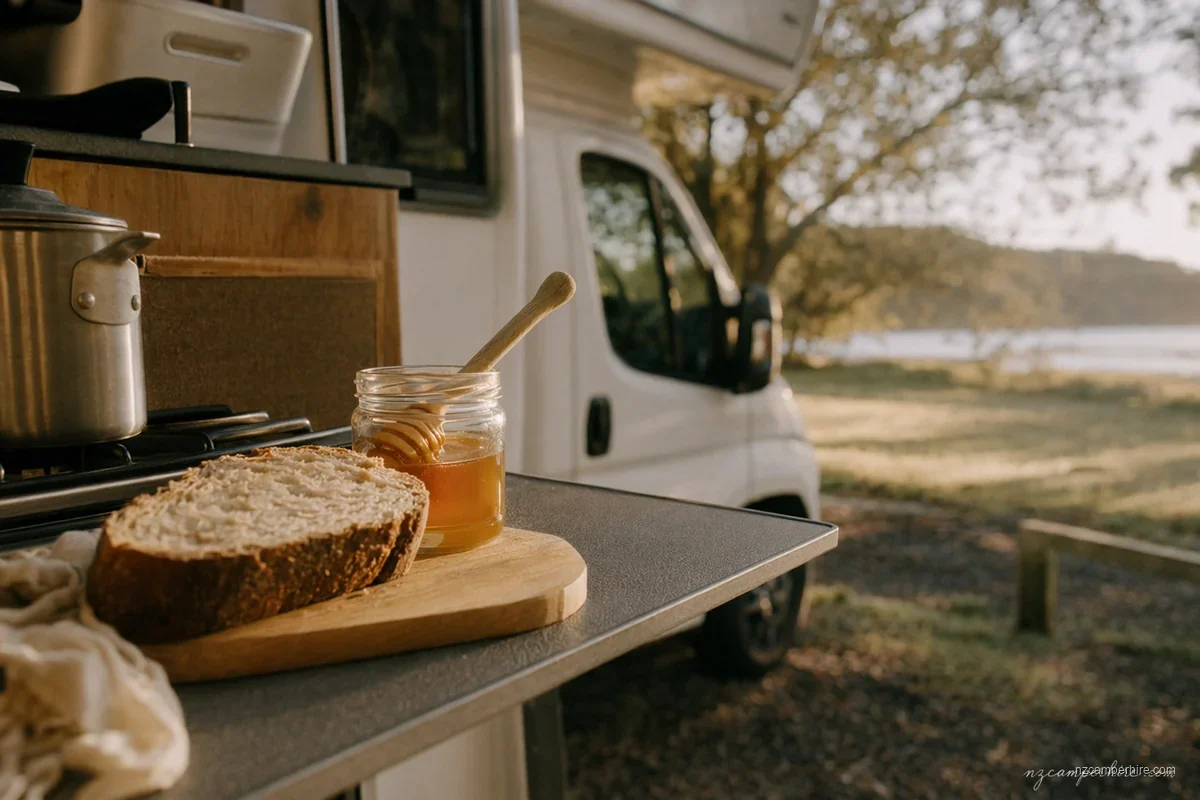
Rules and practicalities are easier to remember when you've felt them — the cold of a wet boot at a freedom camp, the relief of an early ferry slot. This guide is written from those moments, not from a checklist.
Related reading
 ROUTE
ROUTE South Island in 14 days
Classic clockwise South Island loop — Kaikoura, Nelson, West Coast glaciers, Wanaka, Queenstown, Milford Sound, Tekapo, back to Christchurch.
See the route REGION
 Queenstown
Southern Lakes depot. Closest pickup for Milford Sound, Wanaka, Glenorchy, and the Southern Scenic Route.
See the region PRACTICAL GUIDE
 Best time of year for a NZ campervan trip
Month-by-month — weather, demand, school holidays, peak ferry windows.
Read the guideGrey-water dump fees and rules in NZ FAQ
Can I empty grey water onto grass if I used biodegradable soap?
Are NZ dump stations usually free to use?
What is the fine for dumping grey water illegally in NZ?
How often should I empty a motorhome grey-water tank?
Have a planner answer this for your specific trip
Rules and practicalities depend on dates, party size, and route. Send us your outline and we'll come back with answers tailored to your trip.