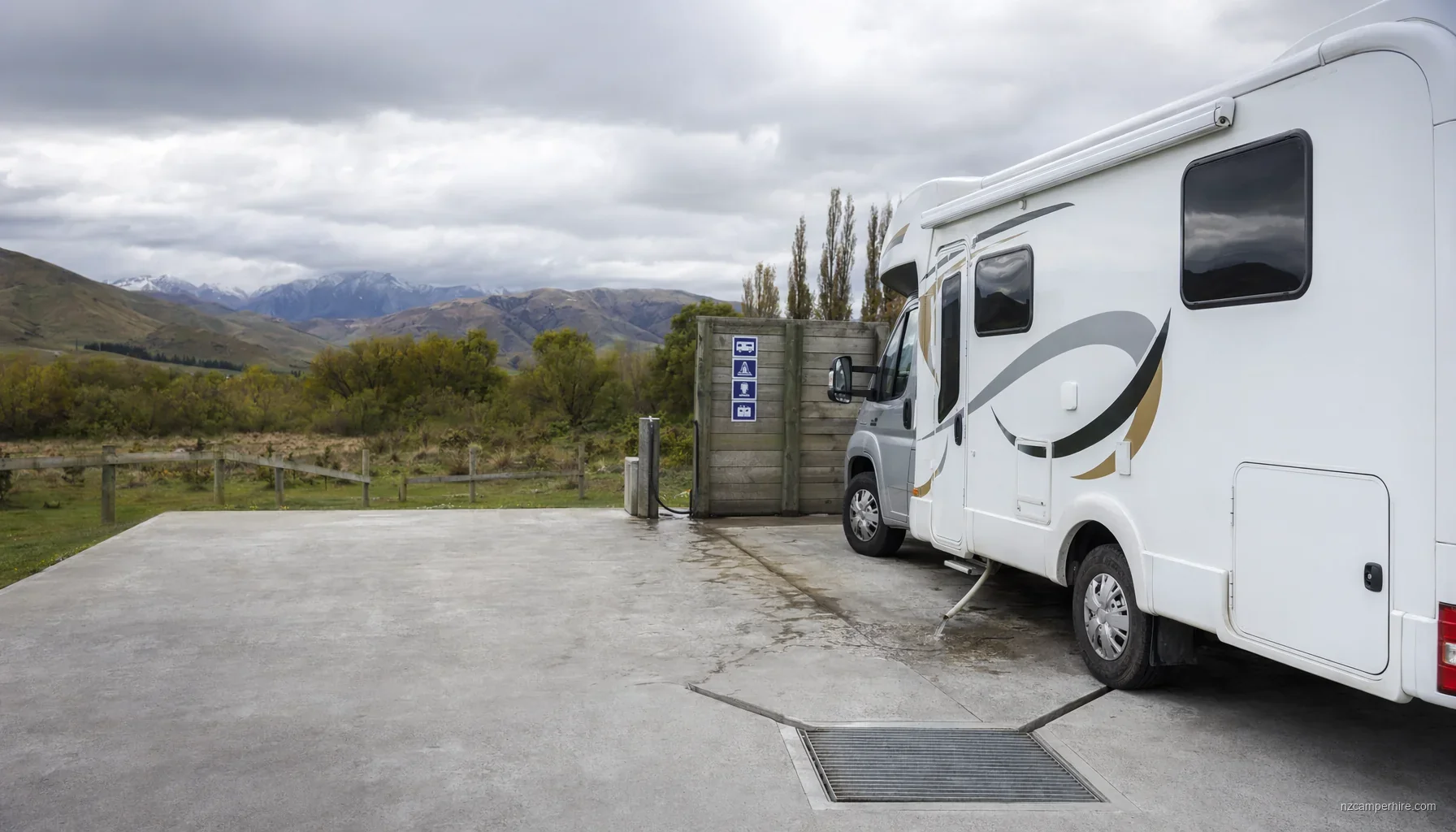
Dump stations South Island map and rules
Where to empty grey/black water on the South Island, fees, etiquette. Honest, granular how-to — written from on-the-ground knowledge, not co...
- logistics
South Island dump stations are easy around Christchurch, Queenstown, Dunedin, Nelson and Picton. They get thin on SH6 through the West Coast, SH94 toward Milford Sound, the Catlins, and the Mackenzie Country if you arrive late.
This is the narrow, practical version of our Dump stations and water fills guide. It matters most on the South Island in 14 days route and the Queenstown + Fiordland loop, especially in January when tanks fill faster and holiday parks are busy. Get the planning checklist that pairs this with the route-level gotchas for your trip, or reply with your dates if you'd like a planner to flag the dump-station-specific traps on your week.
Where the South Island gaps catch people out
Think of dump stations as a chain, not a single pin on a map. Empty before you enter the long scenic legs. On SH73 over Arthur's Pass, the road reaches 920 m and services are limited once you leave Christchurch. On SH6 south of Franz Josef, the gap toward Haast Pass at 564 m can feel longer than the map suggests, especially after rain or road works.
For Christchurch to Queenstown, reset before Lake Tekapo or Lake Pukaki if you are heading for DOC-style camping near White Horse Hill. For Queenstown to Milford Sound, empty in Queenstown or Te Anau before SH94. Cascade Creek is a useful DOC campsite near Milford Sound, not a place to assume you can empty tanks.
Queenstown Lakes is the region where this plays out most strictly. Do not arrive in Queenstown with a full cassette and a grey tank at 90 percent, then expect a freedom camp to solve it.
How to read a map pin without trusting it blindly
A map pin usually means one of four things:
- Council dump station: often available to the public, but may have limited water or awkward turning space.
- Holiday park dump point: reliable if you are staying there; sometimes available to non-guests for a small fee.
- Fuel station or service yard: useful, but hours and access can change.
- Campground listing: check carefully. Toilets do not mean a black-water dump.
Good reset stops by location include North South Holiday Park in Christchurch, Hokitika Holiday Park on the West Coast, Oamaru Top 10, Akaroa Top 10, and Creeksyde Queenstown. In Picton or Nelson, check before you leave town if your next night is a DOC site or a rural freedom-camping area.
Fees, hoses, water fills and basic etiquette
Some South Island dump stations are free. Some ask for a fee, a coin, a key, or a stay at the park. Do not build a route on the idea that every dump point is free and open after dark. In January and February, queues happen at the obvious stops near Queenstown, Wanaka, Tekapo and the West Coast glacier towns.
- Park close enough that your hose reaches, but do not block the turning bay.
- Empty the toilet cassette into the black-water point only.
- Empty grey water through the marked drain, not onto gravel, grass or the roadside.
- Rinse the fitting and leave the bay cleaner than you found it.
- Fill fresh water only from a tap marked potable. Keep that hose away from cassette rinse taps.
A two-person motorhome often needs a proper reset every two or three nights. A family in a 6 m plus vehicle may need it sooner if everyone showers on board.
The legal bit: grey water is not harmless
Dumping grey water illegally is not a minor manners issue. It can carry food waste, detergent and bacteria. Under New Zealand freedom-camping rules, fines can include a $400 instant infringement, up to $200 per litre for illegally discharged grey water, and up to $10,000 in serious cases.
The Freedom Camping Act 2011 still matters, and the 2023 self-containment amendment tightened how vehicles are certified. You will see older references to NZS 5465:2001 and newer green-warrant references under NZS 5465:2022. The key point is simple: self-contained certification means you can hold waste. It does not give you permission to dump it anywhere.
Council bylaws override the national Act locally. Queenstown Lakes, Tasman and Auckland are among the stricter areas, so check the local council page as well as see doc.govt.nz for DOC site details.
Safer fallbacks when the tank plan falls over
If the next dump station is closed, blocked, or too tight for your vehicle, change the night plan early. A holiday park night is the cleanest fallback because you can empty, refill, shower, do laundry and reset food storage in one stop.
On the West Coast, Hokitika Holiday Park is a sensible reset before pushing south. Around Queenstown, Creeksyde Queenstown is useful before or after the Milford leg. Around Christchurch, North South Holiday Park is practical for first-night sorting if you have just picked up a vehicle and are still getting used to driving on the left.
If you are following Freedom camping South Island or Self-contained certification explained, treat a nearly full grey tank as a reason not to freedom camp that night. It is better to pay for one ordinary powered site than spend the next morning hunting for a dump point with a full cassette.
Rules and practicalities are easier to remember when you've felt them — the cold of a wet boot at a freedom camp, the relief of an early ferry slot. This guide is written from those moments, not from a checklist.
Related reading
 ROUTE
ROUTE South Island in 14 days
Classic clockwise South Island loop — Kaikoura, Nelson, West Coast glaciers, Wanaka, Queenstown, Milford Sound, Tekapo, back to Christchurch.
See the route REGION
 Queenstown
Southern Lakes depot. Closest pickup for Milford Sound, Wanaka, Glenorchy, and the Southern Scenic Route.
See the region PRACTICAL GUIDE
 Best time of year for a NZ campervan trip
Month-by-month — weather, demand, school holidays, peak ferry windows.
Read the guideDump stations South Island map FAQ
How often should I empty a motorhome toilet cassette on the South Island?
Can I empty grey water beside the road if it is only sink water?
Are South Island dump stations free to use?
Do DOC campsites have dump stations?
Have a planner answer this for your specific trip
Rules and practicalities depend on dates, party size, and route. Send us your outline and we'll come back with answers tailored to your trip.