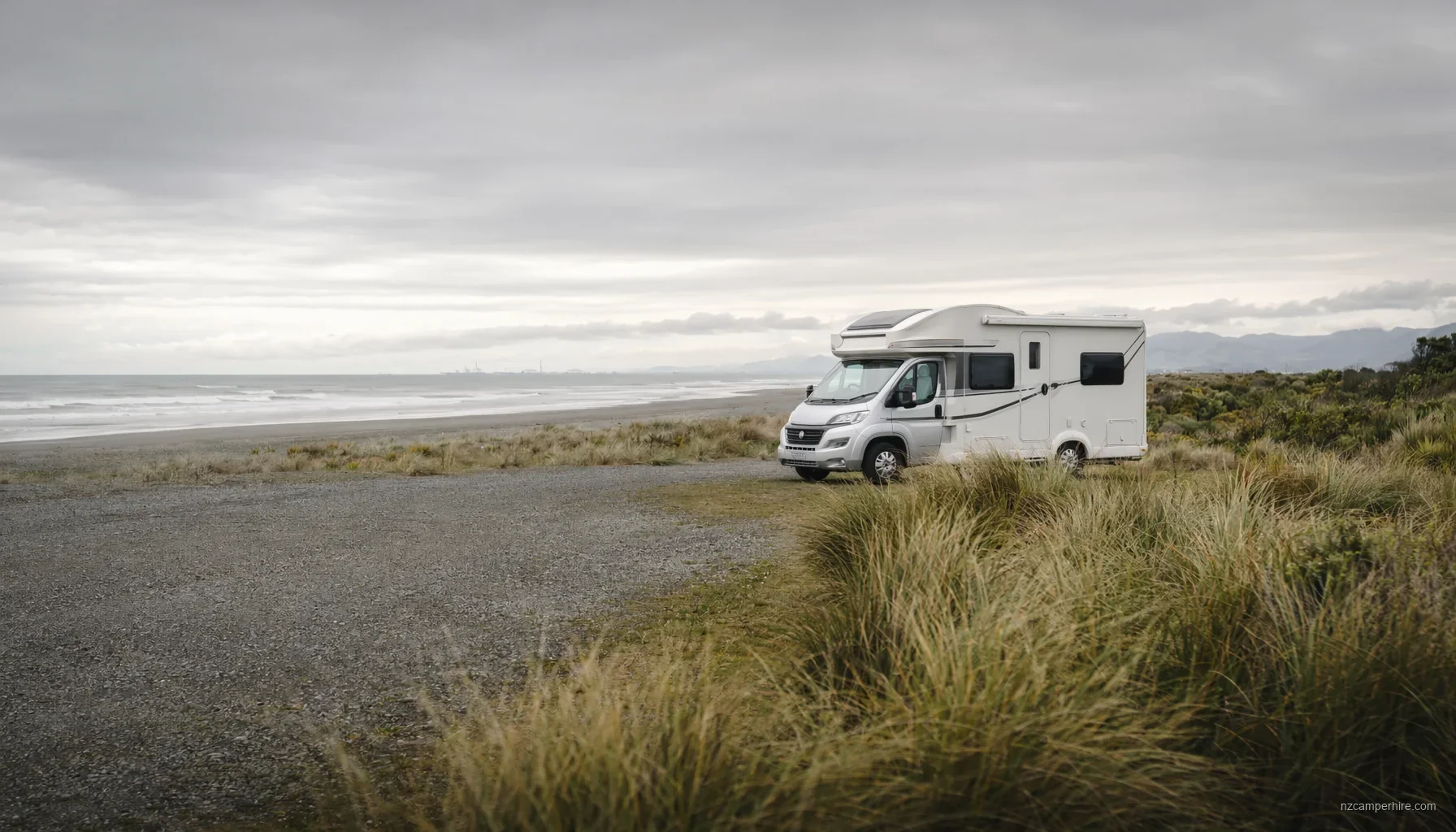
Freedom camping in Christchurch: rules and spots
Christchurch freedom-camp zones, Halswell Quarry, Spencer Park, and what's restricted. Honest, granular how-to — written from on-the-ground ...
- logistics
- free-stays
Freedom camping in Christchurch is possible, but it is not a city where you just pull into any beach car park and sleep. The useful spots are council-controlled, signed, and usually limited to certified self-contained vehicles only.
This matters on the first or last night of a South Island in 14 days trip, and on the Christchurch to Queenstown drive if you pick up late in January. Get the planning checklist that pairs this with the route-level gotchas for your trip, or reply with your dates if you'd like a planner to flag the freedom-camping-Christchurch-specific traps on your week.
The Christchurch rule in plain English
New Zealand’s national law is the Freedom Camping Act 2011, changed by the 2023 self-containment amendment. By 2026, the safe assumption is simple: use a vehicle with a fixed toilet and a valid green self-containment warrant under NZS 5465:2022. The older NZS 5465:2001 blue-sticker system still appears in older advice, but do not rely on it for Christchurch council sites.
Council bylaws override the national Act locally. That is why Christchurch can say yes in one signed car park and no on the next street. Queenstown Lakes, Tasman, and Auckland are even more restrictive, which is why our parent guide, Freedom camping in NZ, always starts with the local bylaw map rather than a camping app.
Fines are real: $400 instant for an infringement, up to $200 per litre for illegal grey-water dumping, and up to $10,000 in serious cases. For the Act and public-land basics, see doc.govt.nz.
Halswell Quarry, Spencer Park, and the signed city sites
Halswell Quarry Park is the Christchurch site most motorhome travellers ask about. It is roughly 17 km from the airport, allow 30 to 40 minutes in a 6 m vehicle because you cross suburban roads, roundabouts, and school traffic. Use only the signed freedom-camping area. Do not assume the wider park, picnic car parks, or nearby residential streets are included.
Spencer Park and the Spencer Beach area are useful if you want the north-east side of the city before joining SH1 toward Kaikoura and Picton. It is about 22 km from central Christchurch, usually 35 to 45 minutes. Again, the legal area is the signed area, not every beach-access car park. The paid Spencer Beach Holiday Park is separate and is a sensible fallback when the signs, space, or weather make freedom camping awkward.
Typical council limits are short stays, self-contained only, no tents, no awnings spreading into the car park, and no waste discharge. Always check the Christchurch City Council freedom camping map on the day, because temporary closures after events, flooding, or maintenance are common.
Where visitors get caught out
The biggest mistake is treating Christchurch as a rural stop. It is a city, with commuters, beach reserves, dog-walking car parks, and neighbours who phone council enforcement when vans line the street.
- Airport pickup nights: after a long flight, left-side driving plus city parking is a poor mix. See Driving on the left in NZ before planning a late arrival.
- Beach car parks: New Brighton, Sumner, and Southshore have restricted areas. A sea view does not make it legal.
- Large vehicles: a 6-berth may fit the legal definition but still be clumsy in marked bays. If the vehicle overhangs, move on.
- Apps: use them for comments, not law. The council sign and bylaw map win.
If you are continuing on the Picton to Christchurch drive or crossing Cook Strait later, remember the ferry side has its own vehicle rules. Check Maritime NZ for the ferry side and the operator instructions before you turn up at Picton or Wellington.
How it fits the first South Island night
Christchurch is often the reset point between flights and open-road driving. Christchurch to Lake Tekapo is about 230 km and 3 hours 15 minutes via SH1 and SH8 in a motorhome, longer with supermarket, fuel, and photos. Christchurch to Queenstown is about 480 km and 6.5 to 7.5 hours, so do not start that after a late pickup.
If you are planning South Island in 10 days or Christchurch to Queenstown in January, a legal first-night stop matters more than saving one campsite fee. January is peak family-holiday season, and the Christchurch region gets busy around beaches and event weekends. For the wider timing picture, pair this with Best time of year for a NZ campervan trip and Self-contained certification explained.
Also check the NZTA / Waka Kotahi rule for road signs and parking controls. If a council sign says no overnight camping, your self-containment warrant does not cancel it.
Safer fallbacks if your vehicle or timing does not fit
Use a paid site when you are not fully self-contained, when you arrive after dark, when you need laundry and showers, or when the council spaces are full. The cheaper night is not cheaper if it earns a fine or a bad first drive.
- North South Holiday Park: handy for the airport and SH1 north or south.
- Tasman Holiday Parks Christchurch: useful for a city night with facilities and public transport options.
- Spencer Beach Holiday Park: practical for the coast and the SH1 run toward Kaikoura.
- Lake Lyndon DOC campsite: about 100 km and 1 hour 30 minutes west on SH73 toward Arthur’s Pass, basic and exposed in bad weather.
If your plan depends on freedom camping every night, rebuild it. Christchurch can work for one legal overnight, but it is not the place to test a vague self-containment sticker, a tired driver, or a vehicle that barely fits a marked bay.
Rules and practicalities are easier to remember when you've felt them — the cold of a wet boot at a freedom camp, the relief of an early ferry slot. This guide is written from those moments, not from a checklist.
Related reading
 ROUTE
ROUTE South Island in 14 days
Classic clockwise South Island loop — Kaikoura, Nelson, West Coast glaciers, Wanaka, Queenstown, Milford Sound, Tekapo, back to Christchurch.
See the route REGION
 Queenstown
Southern Lakes depot. Closest pickup for Milford Sound, Wanaka, Glenorchy, and the Southern Scenic Route.
See the region PRACTICAL GUIDE
 Best time of year for a NZ campervan trip
Month-by-month — weather, demand, school holidays, peak ferry windows.
Read the guideFreedom camping in Christchurch FAQ
Can I freedom camp anywhere in Christchurch if my campervan is self-contained?
Is Halswell Quarry legal for freedom camping?
What self-containment certificate do I need in 2026?
What should I do if the Christchurch freedom-camping spaces are full?
Have a planner answer this for your specific trip
Rules and practicalities depend on dates, party size, and route. Send us your outline and we'll come back with answers tailored to your trip.