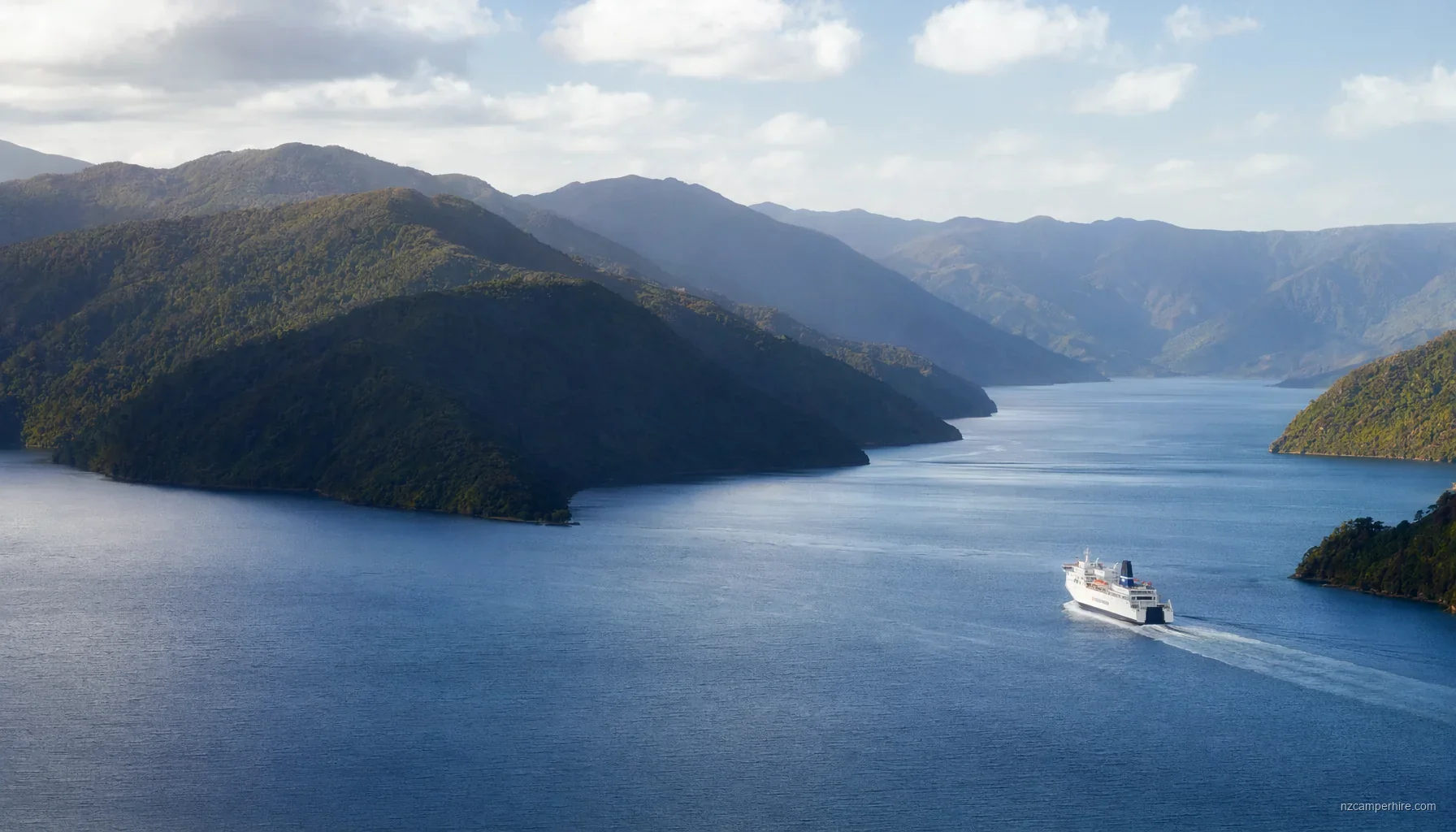
Picton motorhome guide for ferry and Sounds travel
South Island · destination region
- ferry-stage
- boat-in
- busy-summer
- book-ahead
- coastal-stage
On a still morning in Picton, halyards tick softly against the marina masts and the smell of coffee drifts up from the waterfront before SH1 has properly woken.
Picton is not just the place where the ferry door opens. It is the South Island's soft landing: a small harbour town, Queen Charlotte Sound at your shoulder, SH1 south to Kaikoura, and the winding road west to Nelson.
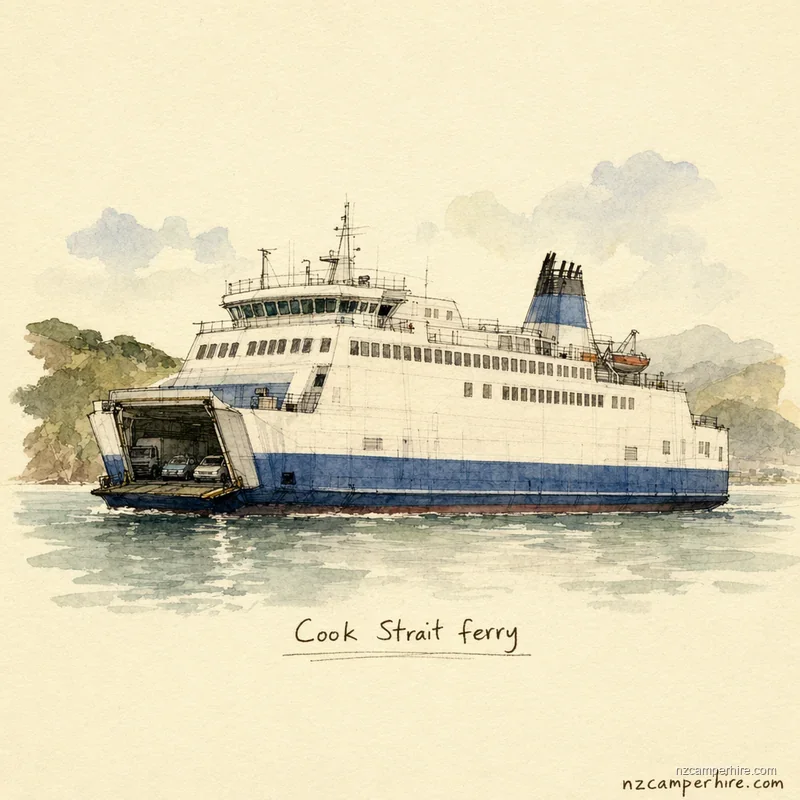
For a first New Zealand motorhome trip, Picton is where timing matters. The Cook Strait ferry takes 3 hours 20 minutes between Wellington and Picton, closer to 3.5 hours once loading is counted, and peak summer vehicle spaces can go months ahead.
See route guides that pass through Picton — and reply with your dates if you'd like a planner to suggest the right number of nights here.
First stop after the ferry, or a base for the Sounds
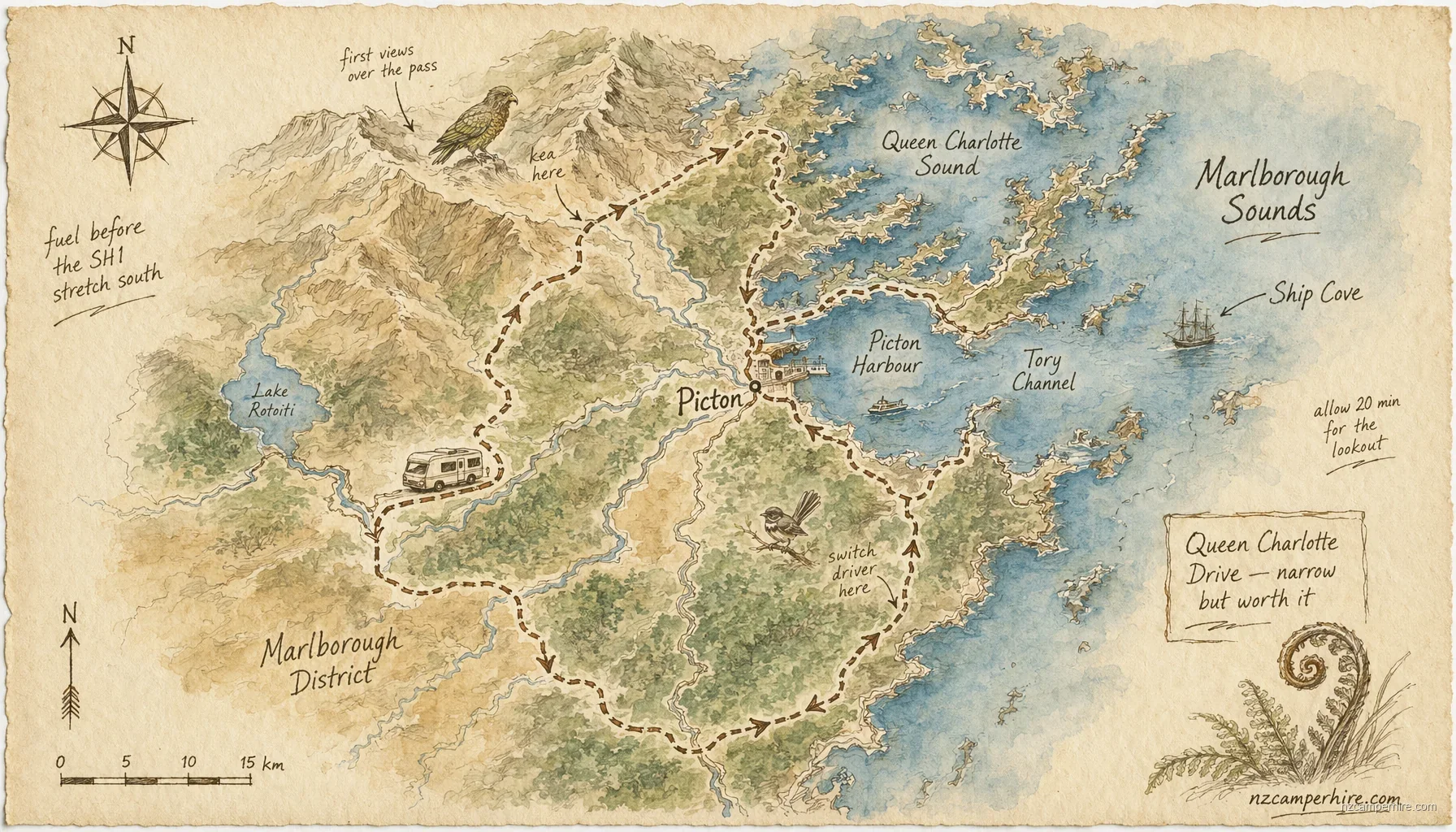
Picton works in two different ways. Some travellers treat it as a ferry recovery night before driving south. Others use it as a small base for the Marlborough Sounds, especially if the route includes the Queen Charlotte Track, a mail boat trip, or a slow day around Waikawa and Anakiwa.
If you are following North to South in 21 days, Picton is the hinge between Wellington and the South Island. If you are on the Kaikoura + Marlborough Sounds route, it deserves more time. The mistake is thinking the ferry arrival time is the same as being ready to drive. By the time you disembark, refuel, shop, and reset your head for South Island roads, an extra hour has gone.
A 2-berth or compact 4-berth is the easiest vehicle size here. A 6-berth is fine on SH1, but less fun on Queen Charlotte Drive and in the tighter waterfront parking areas.
Driving in and out: SH1, Queen Charlotte Drive and SH6
Picton to Blenheim is simple: 28 km, usually 25 to 30 minutes on SH1. Picton to Kaikoura is 156 km and allow 2 hours 15 minutes to 2 hours 45 minutes, because the coastal SH1 section has speed changes, seal works at times, and plenty of places where you will want to pull over properly rather than drift across the centre line.
The quicker road is not always the calmer road; if you are tired from the ferry, choose the easier line even if it gives up a few views.
Picton to Nelson can be done two ways. Queen Charlotte Drive to Havelock is only about 35 km, but allow 50 to 60 minutes because it is narrow, winding, and scenic. From there, continue on SH6 toward Nelson for a total Picton to Nelson drive of about 110 km and 2 to 2.5 hours. If you are tired off the ferry, take the more direct SH1 and SH6 route via Blenheim and Havelock. It is less pretty, but easier.
Picton to Christchurch is 337 km and normally 5 to 6 hours in a motorhome. That is too much after an afternoon ferry. Break it in Kaikoura or Blenheim unless you have arrived early and are already comfortable driving on the left.
Where to stay overnight
Picton has a useful mix of town holiday parks, marina-side stops, and Sounds campsites. Book ahead for late December, January, and long weekends.
- Picton Top 10 Holiday Park: powered and non-powered sites, family-friendly, about 1 km from the waterfront and a short drive from the ferry terminals. Good for a first night because dump, laundry, and showers are straightforward.
- Parklands Marina Holiday Park: powered sites and cabins, relaxed marina and family feel, about 4 km from central Picton in Waikawa. Handy for boat trips, the Waikawa waterfront, and a quieter night than the town centre.
- Alexanders Holiday Park: powered and non-powered campervan sites, small and simple, around 1 km from Picton's shops. Useful if you want to walk into town without being right on the waterfront.
- Smiths Farm Holiday Park, Linkwater: powered and non-powered sites, rural family-run feel, about 25 km and 30 minutes from Picton. Good for travellers heading toward Havelock or wanting a farm setting rather than a ferry-town stop.
- Momorangi Bay Campground: powered and non-powered sites, beach and family feel, about 16 km and 25 minutes from Picton on Queen Charlotte Drive. A good Sounds option if you want swimming, kayaking, and a slower morning.
- DOC Whatamango Bay Campsite: no power, basic bush-and-bay camping, about 13 km and 20 minutes from Picton. Best for self-contained or low-needs travellers who are comfortable without holiday park facilities.
Freedom camping around Picton is controlled by council rules and changes by site. If your vehicle is not certified self-contained, use a holiday park or campground. Read the freedom camping practical guide before assuming a lay-by is legal.
What to see, and what to skip
The best Picton day is often water-based. A Queen Charlotte Sound cruise, mail boat run, or water taxi to a track section gives you the Sounds without asking you to wrestle a motorhome along every side road. If you walk, choose a short Queen Charlotte Track section around Anakiwa, Ship Cove, or Torea Bay depending on transport and time.
At the right tide, Picton has that lovely harbour hush where ropes tap masts and everyone starts walking a little slower.
In town, the waterfront is small but pleasant: marina, cafes, the Edwin Fox Maritime Museum, and short walks such as the Snout Track if you want a proper leg stretch. Waikawa is quieter and better for marina views. Blenheim's cellar doors are close enough for a day trip, but do not try to turn wine tasting into a driving day unless one person is clearly the non-drinking driver.
Skip rushing straight to Nelson on Queen Charlotte Drive in the dark. Also skip trying to park a large motorhome in tiny foreshore spaces during January. Use proper parking, take your time, and accept that Picton is better when you stop treating it as a queue.
How long to stay
The honest minimum is one night, especially after a ferry crossing from Wellington. That gives you time to arrive, settle, shop, empty tanks if needed, and start the South Island rested. A realistic stay is two nights if you want a boat trip or a Queen Charlotte Track day walk.
Three nights is worthwhile if Picton is your Marlborough Sounds base rather than a transit point. That gives you one water day, one wine or Havelock day, and a buffer for weather. January is the peak month, with busy campgrounds, full ferries, and more traffic on SH1. February and March usually feel calmer while still giving warm days.
Use the when-to-go month guide alongside the vehicle-size guide if you are choosing between a compact camper and a bigger family motorhome. Picton itself is manageable, but the side roads are the reason smaller often feels better.
Practical notes for ferry days, fuel and supplies
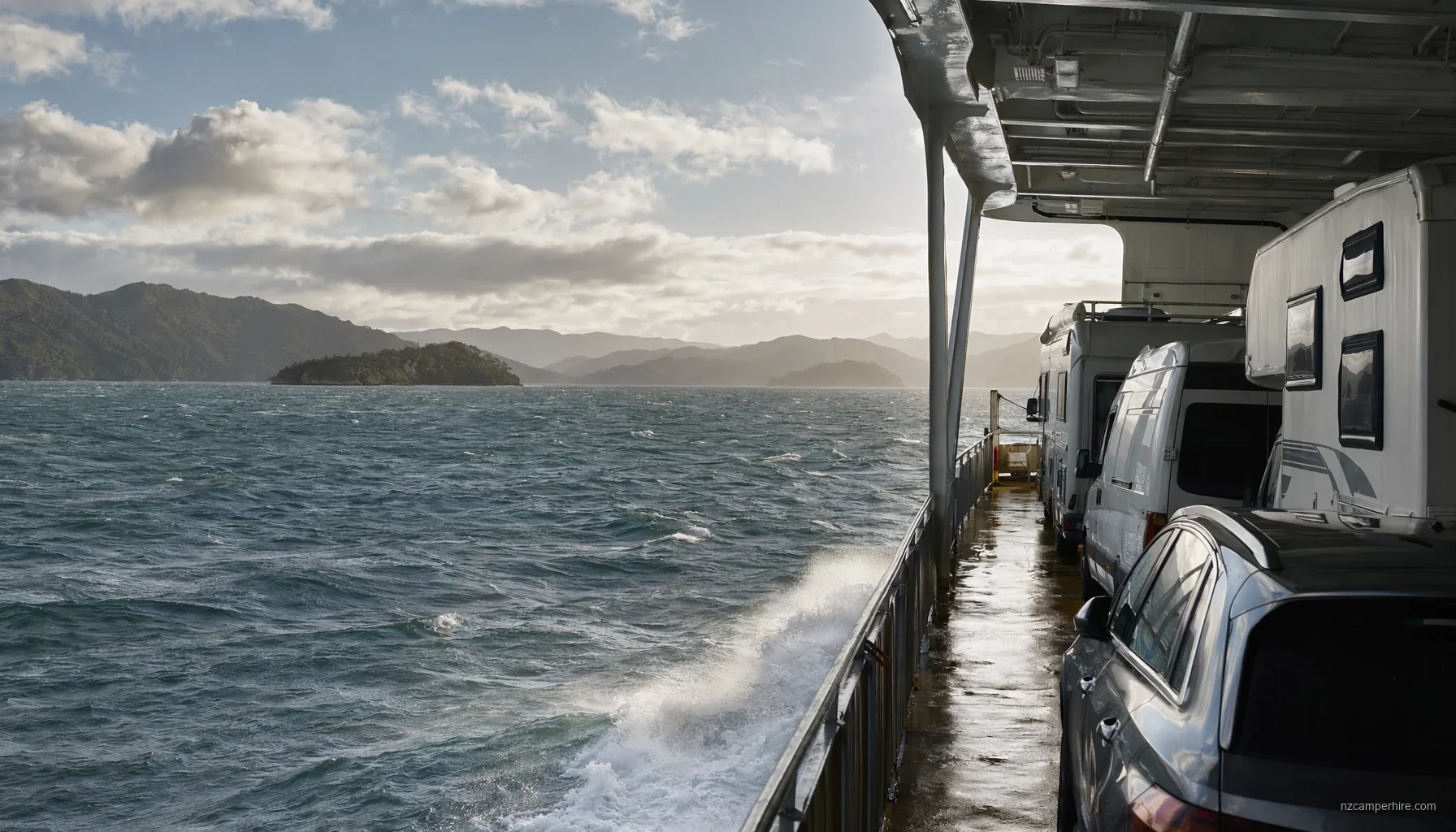
The Cook Strait ferry practical guide matters more here than most first-timers expect. Interislander and Bluebridge both run between Wellington and Picton. The sailing is about 3 hours 20 minutes, but treat the process as 3.5 hours plus check-in time. In December to February, book a motorhome space around 4 months out if your dates are fixed. Two weeks out is not a plan in peak season.
Picton has fuel, cafes, small supermarkets, laundries, and basic repairs, but Blenheim has the wider range. FreshChoice Picton is useful for a normal restock. For a larger shop before the West Coast or Nelson Lakes, many travellers use Blenheim, 28 km south.
Mobile coverage is fine in town and patchier around the Sounds. Download campground details and ferry booking references before driving Queen Charlotte Drive. If your licence is in English it is generally valid for up to 12 months in New Zealand; if not, carry an International Driving Permit or approved translation.
Common first-trip mistakes around Picton
The first mistake is planning a long drive straight after the ferry. Wellington to Picton looks like a break on the map because you are not driving, but ferry days are tiring. You queue, load, wait, unload, then navigate an unfamiliar town on the left side of the road.
The second mistake is underestimating vehicle length when booking the ferry. Your booking needs the correct motorhome length, including bike racks or rear storage if fitted. Turning up with the wrong size can create stress at check-in.
The third mistake is assuming every Sounds road is motorhome-friendly. Queen Charlotte Drive is sealed and popular, but it is still narrow and bendy. Side roads toward Kenepuru Sound can be slower again. If the road looks minor on the map, ask locally before committing a large vehicle.

Picton rewards travellers who linger. Build in one slow morning — coffee on the camp table, the kettle whistling, the day not yet decided.
Waitohi — known internationally as Picton
Eight iwi (often called Te Tau Ihu — 'the prow of the canoe' — iwi) share customary authority across the top of the South Island. The Marlborough Sounds were a major waka (canoe) route and the channel that became today's Cook Strait ferry crossing has been navigated by Māori for around 700 years.
The Marlborough Sounds are Te Tau Ihu o Te Waka-a-Māui — the prow of Māui's canoe. The North Island fish was hauled up using the South Island as the canoe Māui stood in.
- Edwin Fox Maritime Museum, Picton waterfront — Includes pre-European Māori navigation context alongside colonial maritime history. Public ticketed.
- Queen Charlotte Sound / Tōtaranui — Bilingual signage on the Queen Charlotte Track interprets the pre-European pā sites visible from the trail.
Aoraki Routes acknowledges the mana whenua of Te Ātiawa o Te Waka-a-Māui, Ngāti Toa Rangatira, Ngāti Rārua, Ngāti Kuia, Rangitāne o Wairau, Ngāti Apa ki te Rā Tō, Ngāti Koata and Ngāti Tama. We recommend visiting cultural sites with respect and following the tikanga (protocol) of the host iwi.
Related reading
 ROUTE
ROUTE North to South in 21 days
Full NZ road trip — both islands, ferry crossing, all major national parks.
See the route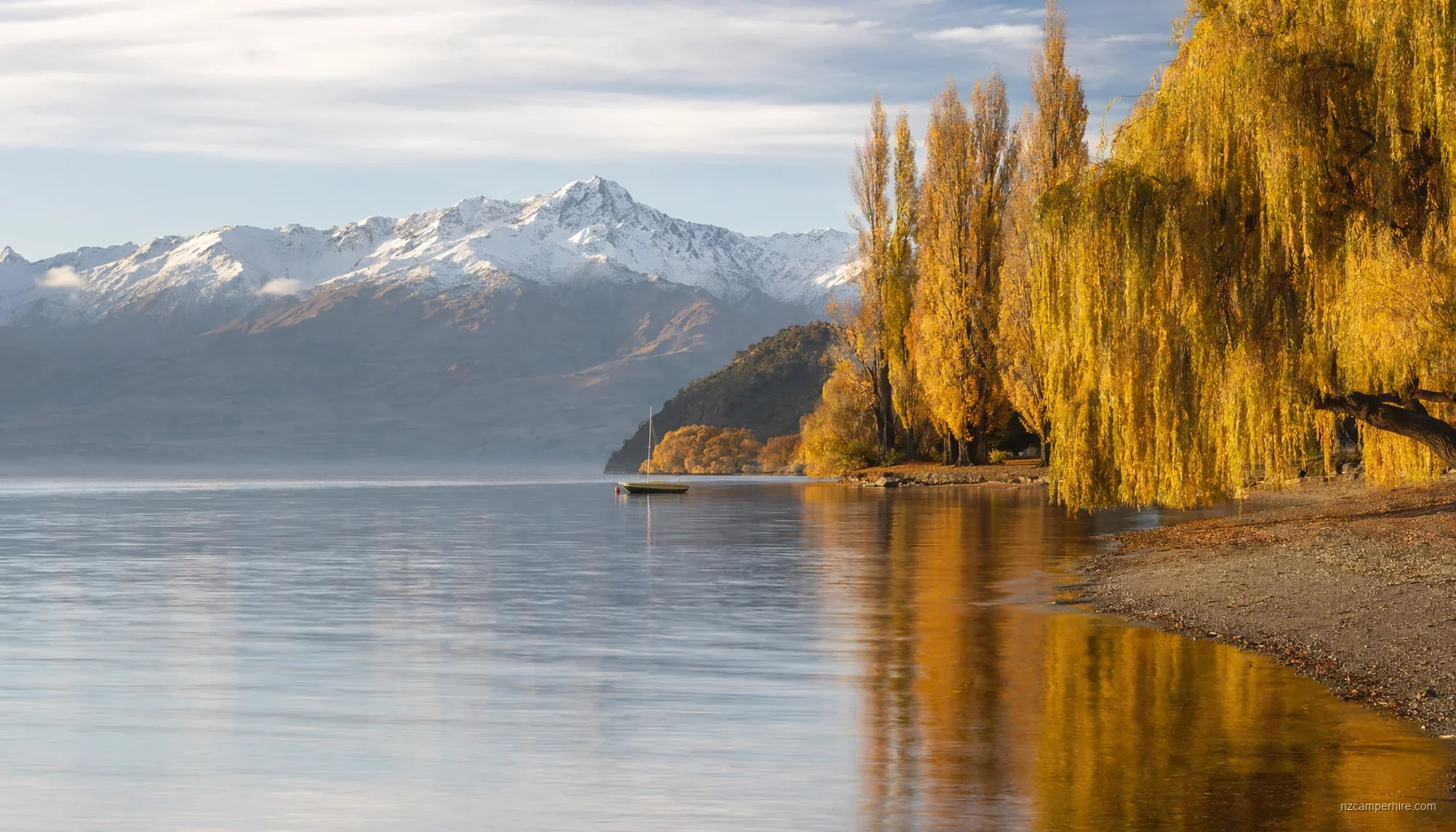 WHEN TO GO
 Shoulder seasons (March-May, September-November)
Sweet spot for many — better availability, lower rates, still good weather.
Read the timing notes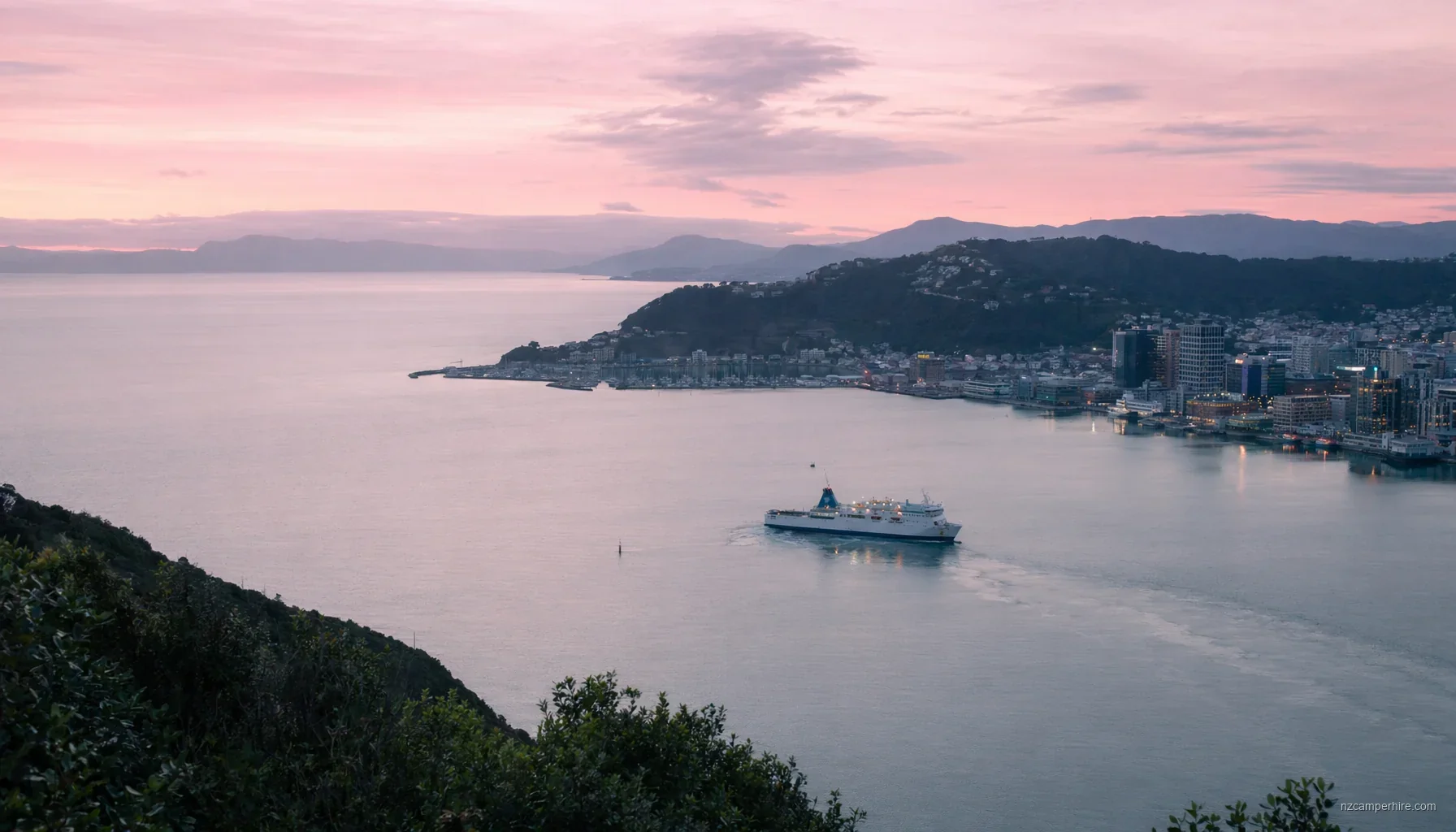 PRACTICAL GUIDE
 Cook Strait ferry with a campervan
Interislander vs Bluebridge, booking tips, what to expect, height/length limits.
Read the guidePicton FAQ
How many nights should we spend in Picton with a motorhome?
When is the best time to visit Picton?
Where is the supermarket in Picton?
Where can we dump grey water and toilet waste in Picton?
Have a planner shape a trip around this region
Tell us roughly when you're coming and how long you have. We'll come back with a route that gives this region the time it deserves.